
Door Refinishing Ormewood Park, GA: Historic Bungalow & Craftsman Door Restoration
One craftsman, one meticulous process. Trusted by homeowners across Ormewood Park, Grant Park, and East Atlanta to restore original Craftsman, Victorian, and mid-century doors against Georgia’s tree-shaded humidity and Beltline-adjacent moisture.
No obligation. Fast, professional response.

Senior Wood Refinishing Specialist · Ormewood Park & Grant Park Corridor
⏱ 11 min read · Updated September 2026
Ormewood Park’s tree-lined streets, Craftsman bungalows, and Beltline-adjacent charm make it one of Atlanta’s most distinctive intown neighborhoods — and one of the toughest on original wood doors. Door refinishing Ormewood Park homeowners can count on means on-site stripping, staining, and sealing that respects a century-old front door instead of replacing it. Door Stain LLC brings the workshop to your driveway, restoring the doors that survived streetcar-suburb subdivisions, a 1920s construction boom, and decades of Georgia humidity — usually in a single visit.
Trusted Door Refinishing for Ormewood Park’s Historic Homes
Homeowners searching for door refinishing Ormewood Park Atlanta are usually dealing with one of two problems: a door that has been painted over so many times the original wood grain is barely visible, or a door that has started to gray, crack, or swell from years of shade and moisture. Both are common in a neighborhood platted in 1892 and built out in waves through the 1920s construction boom, the postwar cottage era, and today’s wave of thoughtful infill. Door Stain LLC has spent over 15 years refinishing doors across Metro Atlanta, and Ormewood Park’s mix of Victorian, Craftsman, and mid-century housing stock is exactly the kind of variety our on-site process was built to handle. We do not run a shop that requires you to remove your door and go without a secure entrance for a week — we unhinge, cover the opening temporarily, and complete the full refinishing process on location.
Ormewood Park sits just southeast of downtown Atlanta, between Grant Park and East Atlanta, with direct access to the Atlanta Beltline running along its western edge. That location is a selling point for residents and a genuine challenge for their doors: the combination of mature tree canopy, close-set historic lots, and Georgia’s humid subtropical climate creates conditions that accelerate finish failure faster than in newer, more open suburban developments. Understanding that microclimate is the starting point for any refinishing plan in this neighborhood.
Why Ormewood Park’s Tree Canopy and Humidity Take a Toll on Wood Doors
Atlanta’s climate is hard enough on exterior wood without added shade, but Ormewood Park’s older-growth trees compound the problem. Deep porches and heavy canopy coverage keep doors out of direct sun for much of the day, which sounds protective until you consider what that shade traps: moisture. A door that never fully dries between Georgia’s frequent summer storms is a door where the finish breaks down from underneath, long before it looks bad from the street. That is the difference between a surface issue a coat of paint can hide and a structural one that requires proper stripping, sanding, and repair before refinishing can even begin.
Homeowners in comparable historic, tree-heavy Atlanta neighborhoods — Virginia-Highland and Grant Park among them — report the same pattern: finishes that would last five or six years in a full-sun suburban setting start failing in three. Add Ormewood Park’s clay-heavy soil, which shifts with seasonal moisture and can cause door frames to rack slightly out of square over time, and you get sticking doors, gapping panels, and finish that cracks along stress points rather than fading evenly. A refinishing job that only addresses the visible surface, without correcting fit and sealing exposed end grain, tends to fail again within a year or two.
Atlanta’s broader climate profile makes the problem worse before it gets better. The metro sits in a humid subtropical zone with roughly 50 inches of annual rainfall, long, muggy summers, and enough freeze-thaw cycling in winter to stress a finish that is already compromised. A door that absorbs moisture during a July thunderstorm and then contracts during a January cold snap is under repeated mechanical stress at exactly the seams and joints where a factory or big-box finish is weakest. In a full-sun suburban setting, at least the door dries out quickly between events. In a shaded Ormewood Park side yard, it often does not fully dry before the next round of rain arrives, which is why we see finish failure here on a shorter cycle than in newer, more open developments farther from the urban core.
The Beltline’s Shade and Moisture Effect on Entry Doors
Properties directly along or near the Beltline corridor see an additional variable: reflected moisture and debris from the trail’s landscaped buffer, plus the general humidity retention of a linear green space cutting through dense residential blocks. Doors on the trail-facing side of a home often show more advanced wear than doors on the street-facing side of the same house, which is why we inspect all exposures — not just the most visible one — before recommending a refinishing scope. The goal is a finish system matched to how much moisture exposure a specific door actually sees, not a one-size-fits-all approach borrowed from a drier suburb. Homes closer to Grant Park, at the neighborhood’s western edge, tend to share this same canopy-driven wear pattern, which is part of why we treat the two neighborhoods as a single service cluster rather than isolated markets.
Craftsman Bungalow, Victorian, and Mid-Century Door Styles We Restore
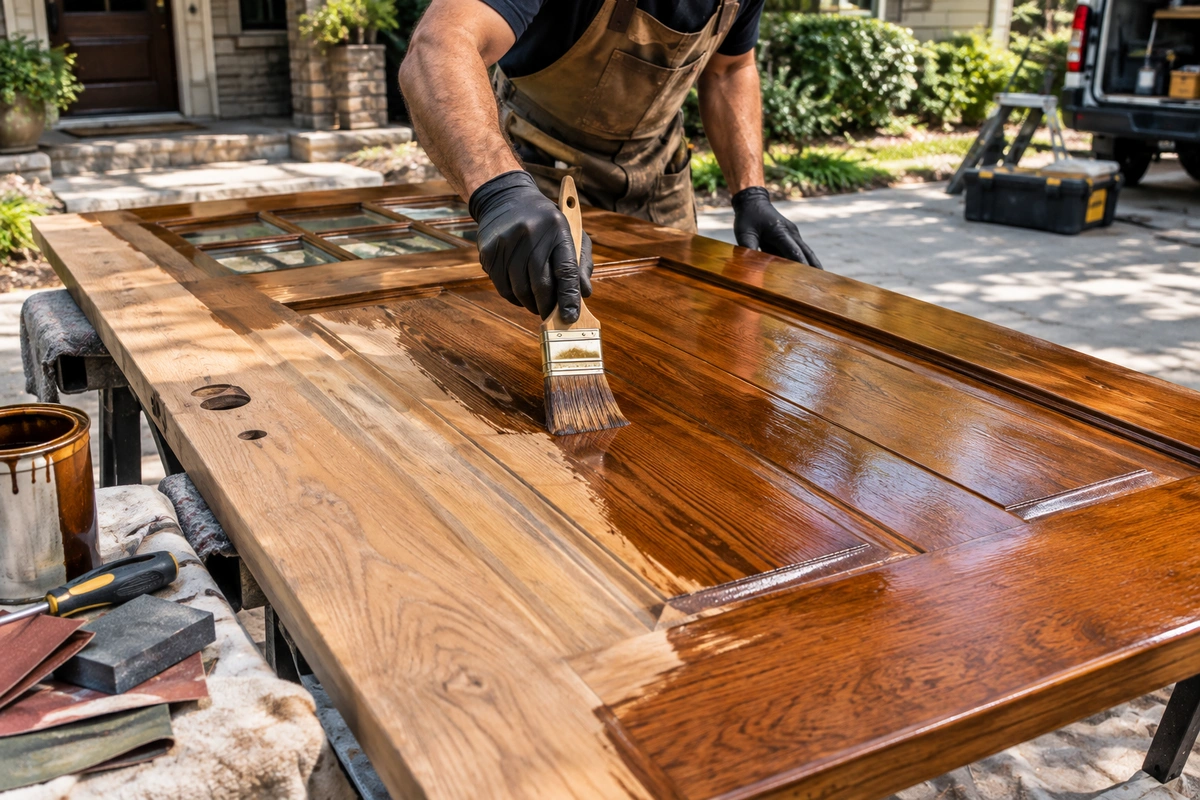
Ormewood Park’s architectural range is unusually wide for a neighborhood its size, and each era of construction brought a different door style — which means a different refinishing approach. Craftsman bungalow door refinishing is the most common request in the neighborhood, reflecting the early-1900s streetcar-suburb homes that make up much of the historic core. These doors typically feature simple, honest joinery — vertical panels, small lite windows, minimal ornamentation — built from old-growth heart pine or fir that, once properly stripped, reveals a grain density modern lumber rarely matches.
Original Wood Entry Doors in Pre-1930s Homes
For historic door restoration Atlanta projects specifically, our process starts with identifying whether the door is original to the home or a later replacement, since that changes both the value of preserving it and the techniques required. Queen Anne and Victorian-era doors, which appear on some of Ormewood Park’s oldest lots, often carry more elaborate millwork, raised panels, and sometimes leaded or textured glass inserts that require careful masking during stripping and staining. We treat glass, hardware, and decorative trim as elements to protect and work around, not obstacles to remove — original hardware in particular is difficult or impossible to replace with anything of comparable quality.
Mid-Century Ranch and Modern Infill Doors
The neighborhood’s postwar construction boom brought simpler wood-sided cottages and, later, mid-century ranch-style homes with flatter, less ornamented doors. These respond well to a cleaner, more modern stain profile, and we frequently pair them with updated hardware finishes when homeowners want a refreshed look rather than a strict historic match. Ormewood Park’s recent wave of new construction and thoughtful infill has also brought contemporary doors — fiberglass with wood-look grain, solid modern slab doors — into the mix, and our modern door refinishing techniques extend to these materials as well, using gel stains and UV-resistant clear coats engineered for non-traditional substrates.
Choosing Stain Colors and Finishes for Ormewood Park’s Architecture
Color selection is not purely aesthetic in a neighborhood this architecturally mixed — it also affects how visible future wear will be and how well the finish reads against a home’s existing trim and brick or siding tone. On the Craftsman bungalows that dominate the historic core, deeper stain tones — mahogany, walnut, and warm chestnut — tend to complement the low, horizontal roof lines and exposed rafter tails typical of the style, while also masking minor grain inconsistencies that come with older, hand-planed lumber. On Victorian-era homes with more ornate millwork, a slightly lighter stain can actually highlight the carved detail rather than let it disappear into shadow, which matters on porches that already sit under heavy tree cover for most of the day.
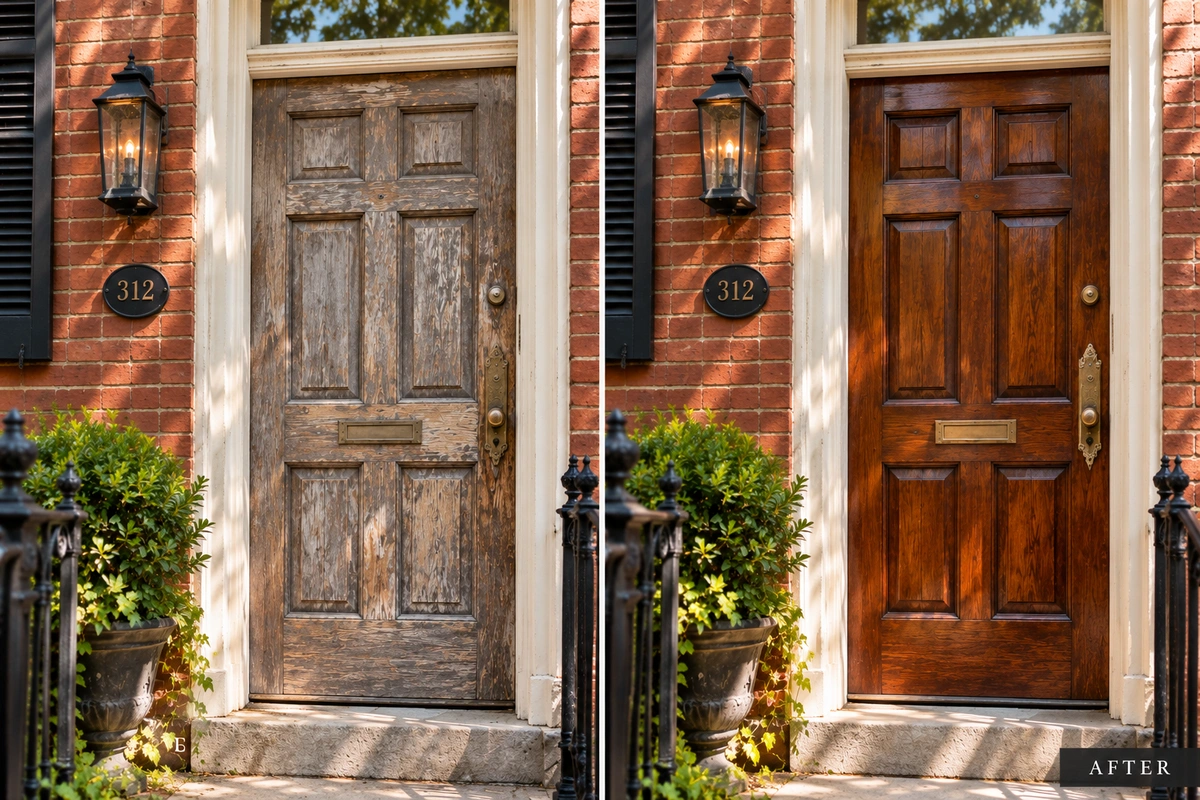
For homeowners leaning toward a painted rather than stained finish — common on some of the neighborhood’s postwar cottages — sheen level matters as much as color. A satin or semi-gloss exterior enamel holds up better against Ormewood Park’s humidity than a flat finish, which tends to show water spotting and mildew faster in shaded locations. We walk through both stained and painted options on-site, matching the recommendation to the door’s wood species, its sun and shade exposure, and whether the home falls into a style where preserving a natural wood look carries more long-term value than a painted finish would.
Our On-Site Door Refinishing Process in Ormewood Park
Every project starts the same way: an on-site or photo-based assessment to determine the door’s material, age, and current condition, followed by an honest recommendation on whether refinishing or repair-and-refinish is the right scope. We do not push replacement on a door that can be saved, and we do not recommend refinishing a door that has structural rot beyond what sanding and filling can responsibly correct.
Step-by-Step: From Assessment to Final Seal
Once a project is scheduled, we unhinge the door and secure the entrance with a temporary cover so your home stays protected throughout the day. The on-site door refinishing process then moves through controlled stripping of the old finish, detailed sanding across multiple grits to reach bare wood without damaging original panel lines, and repair of any cracks, gouges, or soft spots before staining begins. For Ormewood Park’s shaded, moisture-prone doors, we pay particular attention to sealing exposed end grain at the top and bottom edges — the points where water intrusion typically starts — before applying two coats of a premium, UV- and moisture-resistant clear coat suited to Georgia’s climate. Hardware and glass are reinstalled last, and in most cases the finished door is usable again the same day.
On narrow historic lots, where a driveway may be short or shared with a neighbor, we plan the on-site setup to keep the work area contained and out of the way of foot traffic on the sidewalk or Beltline access points. Dust and stripping residue are controlled and cleaned up before we leave, and we walk the homeowner through the finished door in person — checking that it swings, latches, and seals correctly — rather than considering the job done the moment the last coat goes on. If a project uncovers rot or damage more extensive than initially visible, we stop and discuss options with the homeowner before proceeding, rather than making that call unilaterally mid-project.
Door Refinishing vs. Replacement for Ormewood Park Homes
For most Ormewood Park homeowners, the door refinishing vs. replacement Ormewood Park question comes down to what the door represents. An original Craftsman or Victorian-era entry door is difficult and often impossible to source new — the proportions, panel details, and old-growth lumber simply are not being reproduced at scale. Refinishing preserves that character while addressing the actual problems (finish failure, surface wear, minor rot) at a fraction of the cost and disruption of a full replacement. Full replacement makes more sense when a door has extensive structural damage, has been altered beyond reasonable repair, or when a homeowner specifically wants a different architectural statement — glass panels or a modern slab door, for example — rather than a restoration of what is already there.
We walk every Ormewood Park homeowner through both options honestly, including cases where refinishing genuinely is not the right call. Our door refinishing vs. replacement breakdown covers the decision in more depth, including how it plays out differently across Atlanta’s historic neighborhoods versus its newer suburban developments.
A useful rule of thumb: if the door still closes and seals correctly and the damage is limited to the finish and surface wood, refinishing almost always wins on both cost and preservation value. If the frame itself has racked out of square, or if water has been intruding long enough to compromise the door’s core structure, replacement becomes the more honest recommendation — and we would rather tell an Ormewood Park homeowner that upfront than sell a refinish that will not hold.
What Affects Door Refinishing Cost in Ormewood Park
Pricing depends on the door’s material, its current condition, the complexity of any glass or decorative millwork, and how much repair is needed before refinishing can begin — we do not publish fixed rates without seeing the door, but the table below outlines the general factors that move a project from a straightforward refinish into a more involved restoration.
| Project Scope | Typical Condition | What’s Involved | Relative Investment |
|---|---|---|---|
| Standard Refinish | Faded or worn finish, sound wood underneath | Strip, sand, stain, seal — single door, minimal repair | Lower |
| Refinish with Repair | Minor cracking, small soft spots, loose panels | Above, plus wood filling, panel re-securing, spot repair | Moderate |
| Historic Detail Restoration | Original leaded glass, decorative millwork, aged hardware | Careful masking and hand-detail work around glass and trim; hardware preservation | Moderate to Higher |
| Double Door / Multi-Door Projects | Matched entry sets, sidelights, transoms | Coordinated color and sheen matching across multiple units | Higher |
Every quote is confirmed after we see the door in person or review clear photos — the fastest way to get an accurate number is to text a photo directly to our team, as described in the Free Quote section below.
Historic District Considerations for Ormewood Park Doors
Ormewood Park has been identified in Atlanta Urban Design Commission survey work as eligible for local historic district status, though it has not been formally adopted as a designated historic or landmark district at this time — meaning most Ormewood Park properties do not currently require a Certificate of Appropriateness review before exterior work like door refinishing. That said, designation status can vary by exact parcel and can change over time, so homeowners considering more than routine refinishing — particularly a change in door style, color, or hardware on a highly visible historic home — should confirm their property’s current status through the City of Atlanta’s GIS property information tool before starting work. We are happy to note where a project appears to touch on preservation considerations, though we always recommend homeowners verify designation status directly with the city rather than relying on a contractor’s assumption.
What Ormewood Park Homeowners Are Saying
Real feedback from verified Door Stain LLC customers, rated 4.9 out of 5 across 235-plus Google reviews:
“A big thank you to Doorstain for the superb wood refinishing job! My floors look stunning, and the team was courteous and professional. Definitely recommending them to others!” — Nanfuka Brenda
“Door Stain Refinishing is the best! They have refinished my doors multiple times, their product is the best and it really does last a long time, even in direct sunlight! They also recently started doing Metal Door Refinishing which is amazing. So far after working with them for 5 years, I can say I am super happy with the results I’ve seen every time.” — Micrer 3D
“I had a fantastic experience with Door Stain – Door & Restoration in Atlanta. They transformed my wooden doors beautifully with their expert staining and finishing. The team’s professionalism and attention to detail were outstanding.” — Hossein Sharifi Nasab
Serving Ormewood Park and the Surrounding Intown Neighborhoods
Ormewood Park does not sit in isolation — it borders Grant Park to the west, East Atlanta to the east, and shares the same historic streetcar-suburb DNA as Virginia-Highland and Inman Park farther north. We treat Ormewood Park as part of the same intown service cluster covered in our broader areas we serve across Atlanta overview, and homeowners comparing notes with neighbors in those communities will recognize the same on-site process, the same climate-driven finish system, and the same commitment to preserving original woodwork rather than defaulting to replacement.
For homeowners weighing a broader restoration beyond the front door — cabinetry, staircases, or other original millwork common in Ormewood Park’s older homes — our wood repair and restoration services in Atlanta page covers the full scope of what we handle across the metro’s historic neighborhoods. And for homeowners still deciding whether their specific door is a refinishing candidate or a replacement case, our analysis of why Georgia homeowners choose refinishing over replacement lays out the cost and preservation reasoning in more detail, alongside our metro-wide wood door refinishing in Atlanta service overview and our main door refinishing Atlanta hub page for homeowners comparing service across the wider metro.
Homeowners researching options across the neighborhood’s edges — toward East Atlanta, Grant Park, or the Beltline’s connection north toward Reynoldstown — will find the same craftsmanship standard applied consistently, since our areas we serve across Atlanta coverage treats these bordering communities as one continuous historic-neighborhood service zone rather than a patchwork of separately priced markets.
Whether your door is an original 1910s Craftsman panel door, a postwar cottage entry, or a newer piece of Ormewood Park infill construction, the same principle applies: refinishing done correctly for this neighborhood’s specific moisture and shade conditions lasts longer than a generic approach borrowed from a drier, sunnier suburb.
Get Your Free Door Refinishing Quote in Ormewood Park
Door Stain LLC is based at 2582 Post Oak Tritt Rd, Marietta, GA 30062, and serves Ormewood Park as part of our Metro Atlanta on-site service area. Call or text (770) 999-9982 with a photo of your door for the fastest quote, or use the upload-enabled form below to send project details and photos directly to our team.
Want to send photos of your door? Text two or three photos (inside, outside and a wide shot of the entrance) to (770) 999-9982. A clear photo helps us give you an accurate estimate.
A short drive east into DeKalb County, see Gresham Park front door refinishing for nearby brick ranch homes. North via the BeltLine, see Inman Park wood door refinishing for Victorian-era entries. West across the city, the Victorian and Craftsman homes of the West End historic district are covered on our door refinishing in West End, Atlanta page.
Frequently Asked Questions
1. Do you offer door refinishing in Ormewood Park specifically? Yes. Ormewood Park is part of our Metro Atlanta on-site service area, and we regularly work on the neighborhood’s Craftsman, Victorian, and mid-century wood doors.
2. How long does a door refinish take in Ormewood Park? Most single exterior doors are completed on-site in a single day. Double doors, historic detail work, or projects requiring more extensive repair may take longer — we confirm the timeline after assessing your specific door.
3. Will my home be secure while the door is being refinished? Yes. We unhinge the door and secure the opening with a temporary cover for the duration of the work, so your entrance stays protected throughout the process.
4. Can you match the original finish on a historic Craftsman or Victorian door? In most cases, yes. We evaluate the door’s original wood species and finish tone and work to match or complement it, particularly important for homes where preserving historic character is a priority.
5. Does Ormewood Park’s tree canopy and humidity affect how you refinish a door? It affects which finish system we recommend. Doors with heavy shade and moisture exposure — common along the Beltline and on tree-covered lots — get particular attention to end-grain sealing and a UV- and moisture-resistant clear coat suited to Georgia’s climate.
6. Do I need historic district approval to refinish my door in Ormewood Park? Most routine refinishing does not require approval, since Ormewood Park has not been formally designated as a local historic district at this time. If your project involves changing the door’s style, color, or hardware, we recommend confirming your property’s current designation status with the City of Atlanta before starting.
7. Do you refinish non-wood doors, like fiberglass or iron doors, in Ormewood Park? Yes. Alongside solid wood doors, we refinish fiberglass doors using gel-stain, wood-grain-look systems, and we restore iron and metal doors as part of our broader Metro Atlanta service.
8. How do I get a quote for my Ormewood Park door? Text a photo of your door and your address to (770) 999-9982, or fill out the upload-enabled quote form on this page. We confirm exact scope and pricing after reviewing your door’s condition.