
Door Refinishing Inman Park, Atlanta
Historic-district-safe refinishing for Queen Anne, Foursquare, and bungalow front doors — restoring original heart-pine and cypress without stripping away the character that made Atlanta’s first planned suburb what it is.
No obligation. Upload a photo, hear back fast.
Senior Wood Refinishing Specialist · Inman Park & Intown Atlanta
⏱ 9 min read · Published September 2026
Inman Park is Atlanta’s oldest planned suburb, and its front doors carry more history than almost any other neighborhood the DoorStain team serves. Walk the curving blocks around Euclid and Elizabeth, or the quieter stretches near Springvale Park, and you’ll find Queen Anne mansions with spindle-turned porch columns standing beside 1920s bungalows and the occasional shotgun house — each with a door built for a different decade, a different budget, and a different kind of wood. Professional door refinishing services matter here in a way they simply don’t in newer subdivisions, because so many of these doors were built from old-growth lumber that hasn’t been commercially available in over a century.
DoorStain brings the same Professional door refinishing services we use across Metro Atlanta into Inman Park, adapted for the neighborhood’s construction era, its local Historic District regulations, and the specific stresses that a 130-year-old streetcar suburb puts on exterior wood. Below is a full look at what makes Inman Park’s doors distinct, how our process adjusts for them, and how to request a free photo quote.
Atlanta’s First Planned Suburb, Built on a Civil War Battlefield
Before it was a garden suburb, the land under Inman Park was farmland belonging to the Hurt family, and it sat directly in the path of Union and Confederate troops during the Battle of Atlanta on July 22, 1864. Two decades later, civil engineer and developer Joel Hurt purchased the property and set out to build something Atlanta had never seen: a residential park connected to downtown by the city’s first electric streetcar line, running along Edgewood Avenue. Hurt formed the East Atlanta Land Company, acquired more than 130 acres, and hired British landscape architect James Forsyth Johnson — a disciple of John Ruskin — to lay out curvilinear streets and open green space rather than a standard city grid. The result, auctioned off starting in 1889, was Atlanta’s first planned suburb, named for Hurt’s friend and business partner, Samuel M. Inman.
Between 1890 and 1910, many of Atlanta’s most prominent families built homes here, including Coca-Cola magnate Asa Candler, whose Classical Revival mansion, Callan Castle, still anchors the corner of Euclid Avenue and Elizabeth Street. That concentrated building period is exactly why Door Refinishing Virginia-Highland and Inman Park get grouped together so often in Atlanta real estate conversation — both are intown, architecturally coherent, early-20th-century districts — but the two neighborhoods’ door stock actually differs in an important way. Virginia-Highland’s building boom ran roughly 1909–1926 and is dominated by Craftsman bungalows. Inman Park’s original core dates a full two decades earlier, to the late 1880s and 1890s, and its door and millwork profiles reflect a heavier, more ornate late-Victorian sensibility before the bungalow style ever became fashionable.
Queen Anne, Foursquare, Bungalow, and Shotgun Doors by Era
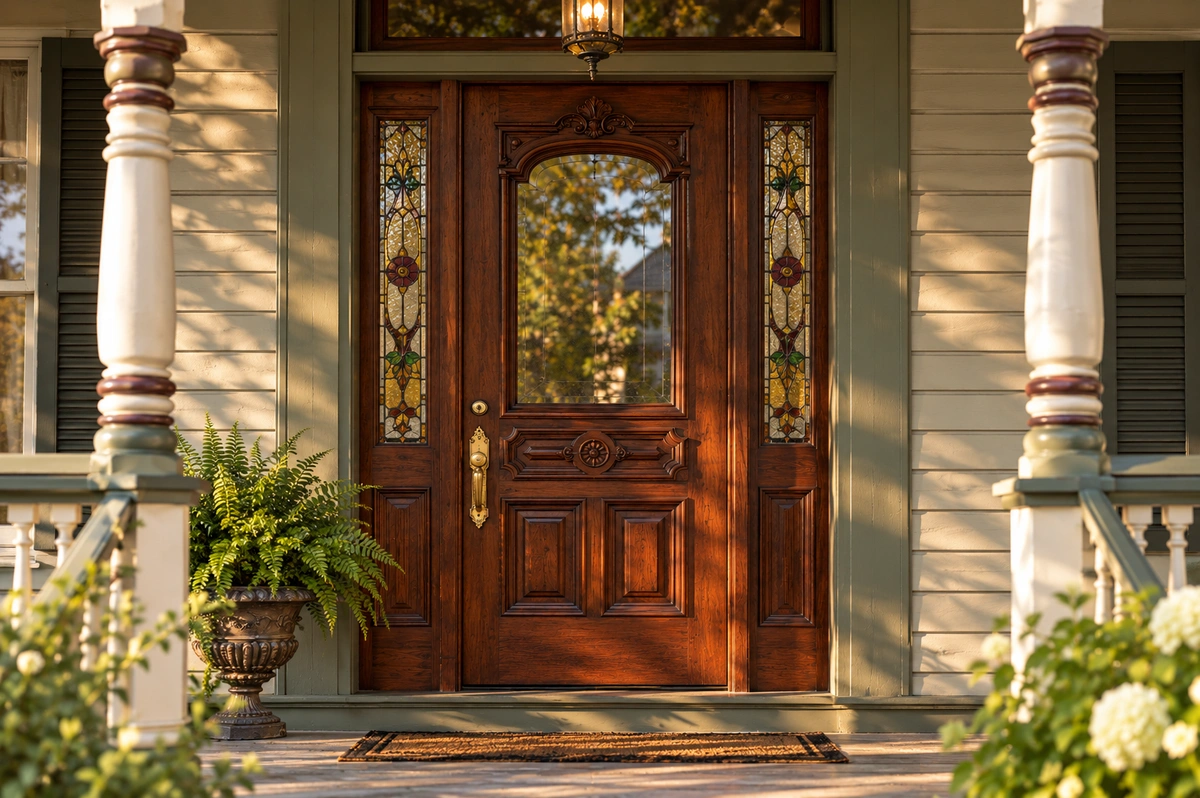
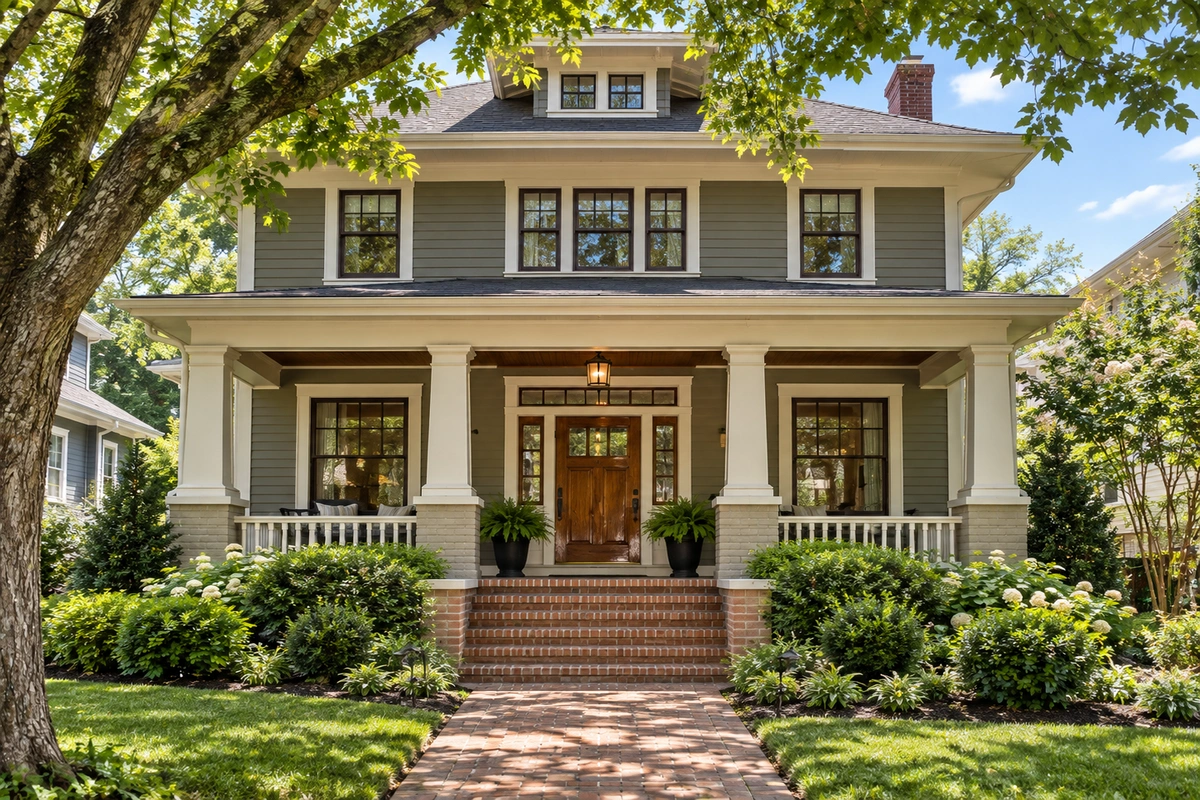
Because Inman Park developed in two distinct waves — the original 1889 Hurt subdivision and a second wave of infill construction in the 1920s and 1930s — the neighborhood’s front doors span an unusually wide stylistic range for a single historic district. The original Queen Anne and Shingle-style mansions typically carry tall, heavy doors with asymmetrical panel arrangements, deep applied moldings, and — on the grandest homes — leaded or stained-glass sidelights and transoms that were custom-built for the opening. Later infill brought Colonial Revival, Romanesque Revival, and Prairie-style details into the mix, along with modest speculative bungalows built on interior lots that had originally been platted as park space. A scattering of shotgun houses along the neighborhood’s western edge, near the former industrial land that’s now Inman Park Village, round out the picture with simpler, narrower door profiles built for a different kind of household entirely.
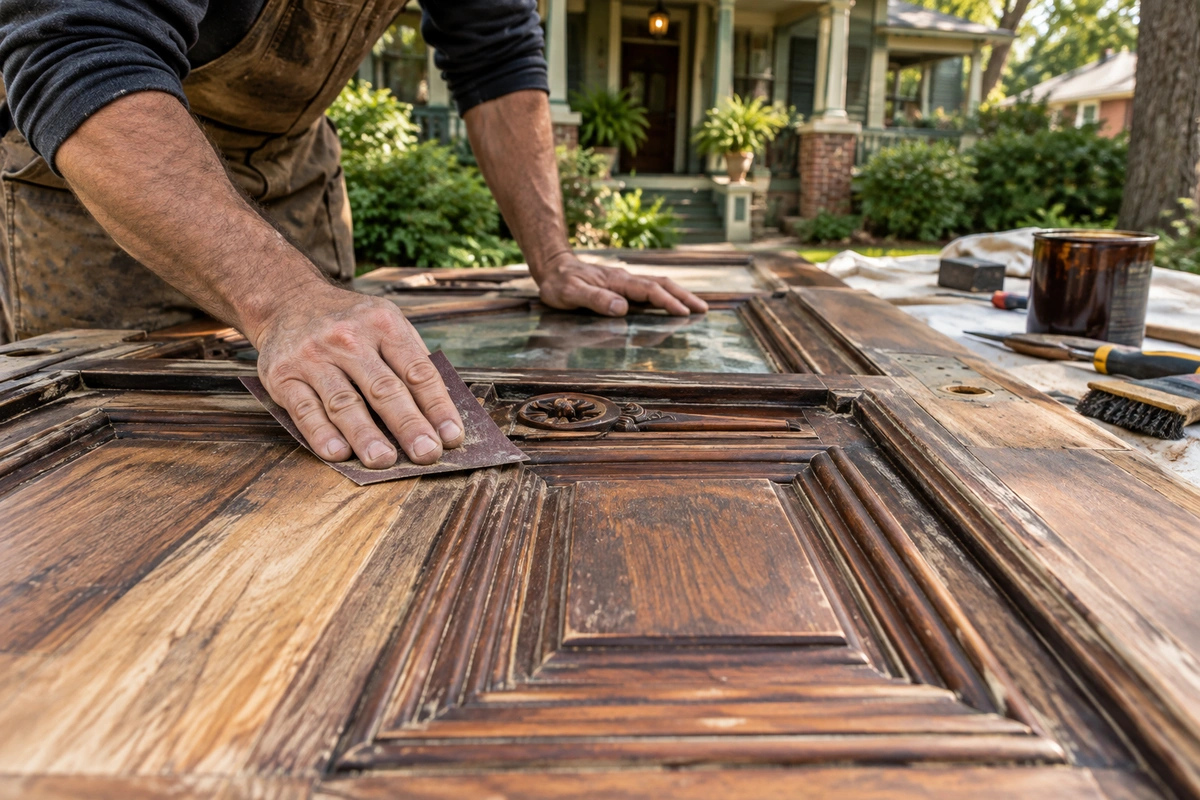
Each of these door types demands a different refinishing approach. Queen Anne doors typically need careful hand-sanding around applied moldings and carved detail that a power sander would blur flat, plus meticulous masking of any original glass. American Foursquare doors, common in the neighborhood’s second wave, usually pair with a transom above that needs color-matching alongside the door itself. Bungalow and shotgun doors are generally simpler in profile but no less deserving of care — many are original to homes built nearly a century ago and represent the same irreplaceable old-growth lumber as their grander neighbors.
The Inman Park Historic District: A Stricter Layer Than a Conservation Overlay
Unlike some nearby intown neighborhoods that fall under a lighter conservation-district review, Inman Park is a full local Historic District under the City of Atlanta’s zoning code (Chapter 20-L, Section 16-20L), first listed on the National Register of Historic Places in 1973 and expanded in 2001. The district is divided into three subareas — public open space, single- and two-family housing along North Highland and Sinclair, and single- and two-family housing around Freedom Park — and any exterior work that requires a building permit may need a Certificate of Appropriateness (COA) from the City of Atlanta’s Urban Design Commission before it proceeds.
Here’s the detail that matters most for a door refinishing project specifically: the City’s own regulations state that a Type I Certificate of Appropriateness — covering ordinary repairs and maintenance — is not required in the Inman Park Historic District. A natural-tone restain that restores a door to its existing appearance generally falls into that ordinary-maintenance category. A more significant change — a different color, a different sheen profile visible from the street, or work bundled with a larger exterior alteration — may fall under the Type II or Type III review process instead, which the City’s own compatibility standard ties to how the district looked in 1945. We’re not a substitute for that review process, and we don’t file COA paperwork on a homeowner’s behalf, but we flag the question during every Inman Park quote so there are no surprises, and we’re glad to work from a color or finish plan a homeowner has already had approved.
Working With the Inman Park Neighborhood Association
The Inman Park Neighborhood Association (IPNA) — Door Stain Team, one of the metro’s most active historic-preservation groups, encourages homeowners pursuing a Type III COA to hold an Immediate Neighbors’ Meeting and, where practical, present their plans at a regular IPNA meeting before applying. That’s a homeowner-to-neighborhood conversation, not something we manage directly, but it’s worth knowing about early if your refinishing project is part of a larger exterior change rather than a straightforward restain.
How Georgia’s Climate Tests Inman Park’s Historic Doors
Inman Park’s climate exposure has its own signature within Metro Atlanta’s broader humid subtropical pattern. Springvale Park and the neighborhood’s mature street canopy create the same shade-and-moisture dynamic found in other intown districts, but Inman Park’s proximity to the BeltLine’s Eastside Trail adds a wrinkle: the corridor’s dense, actively managed landscaping and higher foot traffic mean nearby doors face more airborne organic debris — pollen, leaf litter, and fine grit kicked up along the trail — than doors set back on quieter interior streets. Meanwhile, the neighborhood’s oldest doors, some approaching 135 years old, are built from a denser grade of old-growth lumber than even the bungalow-era stock common in nearby districts, which changes how they respond to Georgia’s humidity swings and UV exposure.
| Season | Primary threat | Typical damage pattern on Inman Park doors | What we address in the refinishing process |
|---|---|---|---|
| Late spring–summer | UV exposure + heat | Finish chalking and fading on the many east- and south-facing Victorian doors along Euclid and Elizabeth | UV-resistant topcoat layers, even-tone re-staining across ornate panel detail |
| Summer–early fall | High humidity + BeltLine-adjacent debris | Trapped pollen and grit along carved molding lines, slow-drying finish near shaded entries | Detail-level cleaning before sanding, moisture-cure timing between coats |
| Winter | Freeze-thaw cycling | Hairline cracking at panel joints on the oldest Queen Anne doors, finish lifting near thresholds | Flexible marine-grade sealants that move with old-growth wood instead of cracking |
| Year-round | Two eras of construction stock | 1880s–1890s old-growth heart pine reacts differently under a sander than 1920s–1930s bungalow-era lumber | Sanding pressure and grit progression calibrated separately by construction era, not a single default |
Our Door Refinishing Process for Inman Park’s Character Homes
Every Inman Park project starts with an on-site evaluation of the door’s era, wood species, and existing finish layers. A Queen Anne door from the original 1889 subdivision often carries a very different finish history than a 1920s bungalow door built during the neighborhood’s second wave, and knowing which era we’re working with shapes the entire approach before any sanding begins. From there, our multi-step process includes deep sanding calibrated to the wood’s age and density, careful masking of original glass and applied moldings, layered staining to restore natural depth and grain definition, and a protective marine-grade topcoat built for Georgia’s humidity swings.
We refinish doors in place whenever the door’s condition allows it, which matters enormously on a door old enough to predate the neighborhood’s decline and 1970s restoration. Removing and transporting a 19th-century door introduces a level of risk that on-site work simply avoids. Most standard projects complete in one to two days; if your property requires a Type II or Type III Certificate of Appropriateness because the work involves a visible exterior change, plan for that municipal review timeline separately from the refinishing work itself, since it runs on the City’s schedule rather than ours. Our before-and-after portfolio includes comparable historic-home projects from elsewhere in the metro.
Materials & Methods for Old-Growth Heart Pine and Cypress
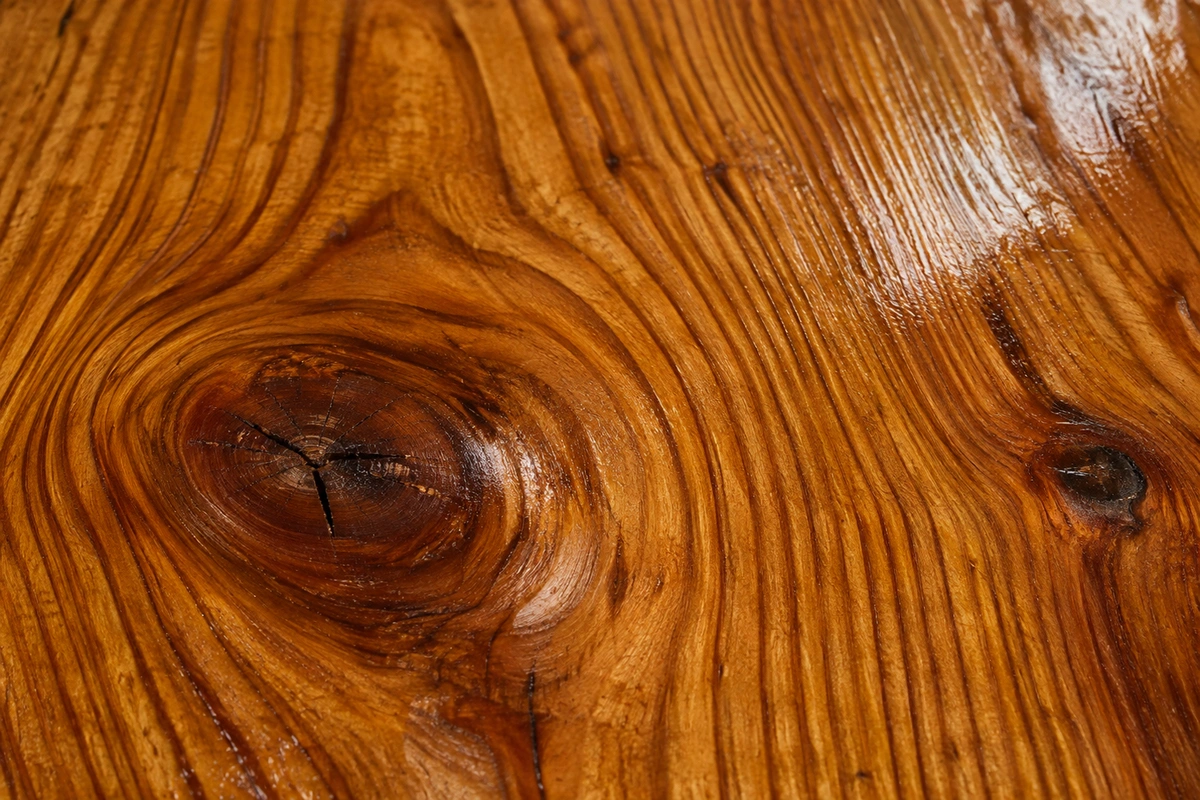
Many of Inman Park’s original 1889-era doors were built from old-growth heart pine or cypress — both notably denser and tighter-grained than the lumber available in modern replacement doors, and both prone to uneven stain absorption if sanded with a standard power-tool grit progression. We hand-sand around any applied molding, carved panel work, or beveled glass rather than risk flattening detail that took a 19th-century craftsman real time to produce. Original glass, hardware, and sidelight framing are masked and protected in place rather than removed, since these are often irreplaceable elements original to the home. Our before-and-after portfolio includes comparable examples from similar historic-home projects. The final protective layer is the same flexible, marine-grade formulation we use across our historic-home projects — designed to move with humidity-driven wood expansion instead of cracking at panel joints, which remains the most common failure point on century-old doors previously refinished with a standard interior-grade product.
Door Refinishing vs. Replacement Near the BeltLine
For an Inman Park home, refinishing is almost always the stronger option over replacement — and inside the Historic District, it’s frequently the path of least regulatory resistance too. A modern replacement door, however well-built, is milled from faster-growth lumber that doesn’t match the density or grain character of an original 1890s door, and a visibly mismatched replacement can draw exactly the kind of Urban Design Commission scrutiny that a like-for-like natural restain avoids entirely. Refinishing preserves the original material, the original proportions, and — where present — the leaded glass, hardware, and transom work that would be expensive or simply impossible to source new. It’s also typically faster: most refinishing projects complete in one to two days, well ahead of the lead time on a custom replacement door built to match a historic opening, before any COA review timeline is even factored in.
Curb Appeal, the Inman Park Festival, and Resale Value
Inman Park’s annual spring festival is one of the reasons a front door here carries more weight than it might in a typical suburb. The festival’s home tour draws thousands of visitors through the neighborhood every year, and a portion of that tour routes directly past — and sometimes into — homes whose owners have opted to showcase their property’s original architectural detail. A front door in poor condition stands out immediately against that backdrop, while a well-maintained original door signals exactly the kind of stewardship the neighborhood’s preservation-minded culture values. Homeowners preparing to list a property, or simply anticipating festival season, often move refinishing up their maintenance calendar for this reason alone.
That same dynamic shows up in resale conversations more broadly. Real estate listings for Inman Park homes routinely call out original doors, transoms, and hardware as selling points precisely because so few comparable original details survive elsewhere in Metro Atlanta. A door that’s peeling, dull, or mismatched to the home’s era can undercut a listing’s broader historic-character narrative, even when the rest of the house has been carefully maintained — which is exactly why homeowners preparing to list often request your free quote well ahead of putting a property on the market. Refinishing — rather than a mismatched modern replacement — keeps that narrative intact and tends to photograph better for listing purposes, since original wood grain and glasswork read very differently in professional real estate photography than a builder-grade substitute does.
Service & Investment Overview
Pricing below is presented as a relative tier structure. Exact dollar figures are pending final client sign-off and will be added once confirmed — do not quote these ranges as final pricing.
| Service tier | Typical scope | Best for | Relative investment |
|---|---|---|---|
| Standard refinish | Single door, sand, stain, seal | Bungalow and shotgun doors with surface fading, no structural issues | $ (pending confirmation) |
| Historic restoration | Door + sidelights/transom, hardware preservation, glass masking | Original Queen Anne and Foursquare doors from the 1889–1926 building period | $$ (pending confirmation) |
| Full entryway restoration | Door, frame, sidelights, transom, hardware refinishing | Historic District homes pursuing a documented, COA-ready finish plan | $$$ (pending confirmation) |
Every quote is based on the same core factors: door size and material, how many finish layers need to be stripped back, whether sidelights or a transom are included, and whether the property’s scope of work is likely to require Historic District review. Because these variables shift project to project, we don’t publish a flat rate — your quote will include an itemized number once we’ve seen photos or completed an on-site evaluation. Warranty coverage on refinishing work is still being finalized on our end and isn’t published yet; ask us directly when you request your free quote and we’ll give you the current answer.
How DoorStain Compares to Other Inman Park Door Refinishers
See the Competitor Gap Analysis table above for the full comparison against Reformation Doors, Door4Life, and the general handyman marketplace listings serving this ZIP code. The short version: no other refinisher currently serving Inman Park addresses the Historic District’s Certificate of Appropriateness process directly, and none offers an on-site photo quote tool.
Neighborhood Coverage Across Inman Park
We serve the full footprint of Inman Park, from the Euclid Avenue and Elizabeth Street core near Callan Castle, to the quieter blocks bordering Springvale Park, to the newer mixed-use pockets along the western edge near Inman Park Village. Whether your door sits inside the mapped Historic District’s Subarea 1, 2, or 3, or in one of the adjoining areas historically known as Moreland Park or Copenhill Park, our process adapts to the door’s construction era and exposure rather than applying one approach across the board.
Homeowners along Moreland Avenue, across which lies Candler Park, and along DeKalb Avenue, bordering Cabbagetown and Reynoldstown, sit at the edges of Inman Park’s footprint but often have the same construction-era door stock as the neighborhood’s core. The same is true near the Little Five Points commercial district to the northeast, where a handful of residential blocks blend into Inman Park’s boundary. Doors along the Eastside Trail corridor itself tend to see the most foot traffic and airborne debris of anywhere in the neighborhood, simply because of how heavily used that stretch of the BeltLine has become — which is one more reason those specific entries often need refinishing sooner than a comparable door tucked away on a quieter interior block.
We also regularly work in the neighborhoods immediately surrounding Inman Park. Door Refinishing Virginia-Highland covers the bungalow-era district directly north, and Door Refinishing Decatur and Door Refinishing Druid Hills cover comparable early-20th-century housing stock to the east. Door Refinishing Brookhaven and Door Refinishing Marietta round out our coverage of the metro’s other historic pockets, and Door Refinishing Alpharetta covers the North Fulton corridor for homeowners with ties to both areas. For the full list of communities we serve, see our Areas We Serve page, and browse our residential door refinishing services across Metro Atlanta for a full breakdown of what a standard project involves.
Just east, the Craftsman bungalows of Candler Park are covered on our door refinishing in Candler Park page.
Caring for Your Refinished Door in Inman Park’s Microclimate
A properly refinished Inman Park door can hold its finish for years, but the neighborhood’s tree canopy and BeltLine-adjacent foot traffic reward a bit of seasonal attention. Wipe down carved detail and applied molding periodically, since pollen and fine grit settle into those recesses faster than on a flat modern door face. Check weatherstripping and threshold seals each spring, particularly on homes near Springvale Park where shade slows drying after rain. Avoid pressure-washing anywhere near a refinished historic door — it can force water past the topcoat and into joinery that’s well over a century old in some cases, and it’s especially risky on doors with original leaded or beveled glass. If a sun-facing door starts to look dull, a maintenance re-coat well before the wood itself is exposed is far less invasive, and far less costly, than a full refinish.
What Inman Park Homeowners Are Saying
The reviews below are verified Google reviews for DoorStain (4.9★ average, 235+ reviews). We don’t yet have Inman Park–specific reviews on file — if you can share any from past Inman Park clients, we’ll swap them in here.
“A big thank you to Doorstain for the superb wood refinishing job! My floors look stunning, and the team was courteous and professional. Definitely recommending them to others!” — Nanfuka Brenda
“Door Stain Refinishing is the best! They have refinished my doors multiple times, their product is the best and it really does last a long time, even in direct sunlight! … after working with them for 5 years, I can say I am super happy with the results I’ve seen every time.” — Micrer 3D
“I had a fantastic experience with Door Stain – Door & Restoration in Atlanta. They transformed my wooden doors beautifully with their expert staining and finishing. The team’s professionalism and attention to detail were outstanding.” — Hossein Sharifi Nasab
Get Your Free Inman Park Door Refinishing Quote
Upload a few photos of your door and tell us about your project below, or request your free quote directly if you’d rather talk it through first, or call (770) 999-9982. Full quote form code is provided in Section 8 below, ready to paste into the page.
Free Inman Park Door Refinishing Quote
Photos help us give you a faster, more accurate estimate.
Want to send photos of your door? Text two or three photos (inside, outside and a wide shot of the entrance) to (770) 999-9982. A clear photo helps us give you an accurate estimate.
No obligation. Fast, professional response.
Frequently Asked Questions
Does my Inman Park home need a Certificate of Appropriateness before refinishing my door?
It depends on the scope of the work. A natural-tone restain that returns the door to its existing appearance typically falls under “ordinary repairs and maintenance,” and the City of Atlanta’s own regulations state that a Type I Certificate of Appropriateness — covering that category — is not required in the Inman Park Historic District. A visible color change or work bundled with a larger exterior alteration may require a Type II or Type III review instead. We flag this during your quote, but the approval process itself is between the homeowner and the Urban Design Commission.
What’s the difference between Inman Park’s Historic District and Virginia-Highland’s conservation area?
Inman Park is a full local Historic District under Chapter 20-L of the City of Atlanta’s zoning code, divided into three subareas with its own Certificate of Appropriateness process. Virginia-Highland’s protection is a conservation-area overlay, which is a related but distinct — and generally less extensive — regulatory tool. Both sit alongside, and separately from, each district’s National Register of Historic Places listing.
My door is well over a century old — can it still be refinished instead of replaced?
In almost every case, yes. We regularly work on doors from Inman Park’s original 1889 subdivision. Old-growth heart pine and cypress are denser and more durable than most people expect, and our process is built around identifying the wood’s condition and finish history before we start, rather than sanding blind.
Do you preserve original leaded glass, sidelights, and transoms common on Inman Park’s Queen Anne and Foursquare doors?
Yes. We mask and protect original glazing, hardware, and sidelight framing rather than removing it, since these details are frequently original to the home and can’t be replicated with modern replacement parts.
How does refinishing differ between Inman Park’s original 1889-era doors and its 1920s–1930s bungalow infill?
The earlier Queen Anne and Foursquare doors typically carry heavier applied moldings, denser old-growth stock, and more elaborate glasswork, which changes our sanding pressure and masking approach compared with the simpler bungalow and shotgun doors built during the neighborhood’s later infill period.
Does the Inman Park Neighborhood Association need to be involved in my refinishing project?
For a straightforward restain, generally no. IPNA involvement typically comes into play for a Type III Certificate of Appropriateness application involving more significant exterior changes, where the City encourages homeowners to hold an Immediate Neighbors’ Meeting first. We’ll flag if your project looks like it falls into that category.
How long does a typical Inman Park door refinishing project take?
Most standard refinishing projects complete in one to two days on-site. If your property requires Historic District review for the specific work involved, budget additional time for that municipal process separately, since it runs on the City’s schedule rather than ours.
Do you offer a warranty on Inman Park refinishing work?
Warranty terms are being finalized and will be published here once confirmed. Please ask our team directly for current coverage details when you request your quote.